Database Connections Exhausted at Peak Traffic — Even With SetMaxOpenConns Set
You configured the pool. You set the limit. And yet, at 9am on Monday, your Go service starts throwing:
driver: bad connection
sql: database is closed
context deadline exceeded
Here’s what’s actually happening — and how to fix each cause.
What SetMaxOpenConns Actually Does
db.SetMaxOpenConns(25)
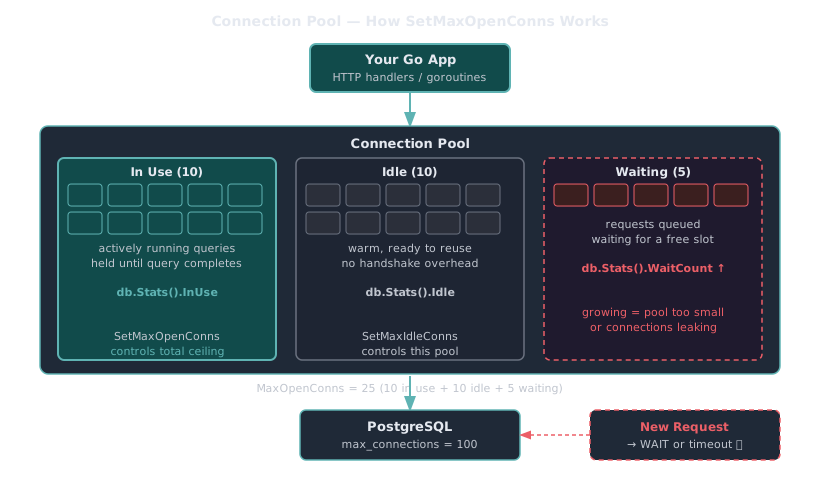
It caps how many connections can be open at once. But it does not prevent exhaustion on its own. Here’s why.
Culprit #1 — Connection Leak (The Most Common One)
You query the DB, forget to close rows, and the connection never returns to the pool.
// ❌ LEAKING — rows never closed
func getUsers(db *sql.DB) {
    rows, err := db.Query("SELECT id FROM users")
    if err != nil {
        return
    }
    // forgot rows.Close()
    // connection is now held forever
}
What this looks like over time:
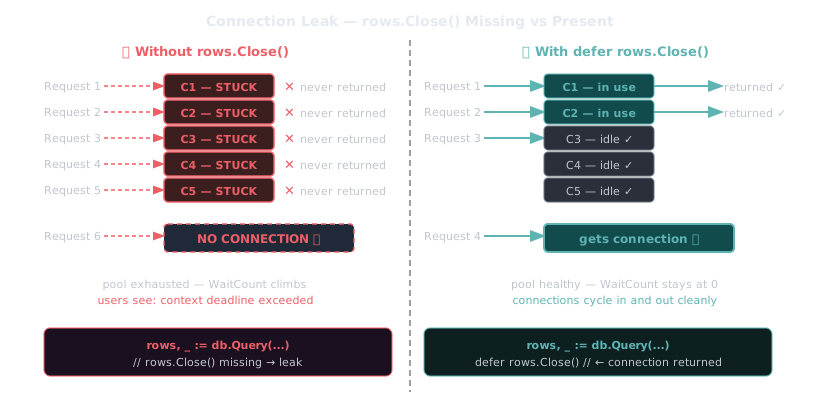
The fix:
// ✅ Always defer rows.Close()
func getUsers(db *sql.DB) ([]User, error) {
    rows, err := db.Query("SELECT id, name FROM users")
    if err != nil {
        return nil, err
    }
    defer rows.Close() // ← this line saves you

    var users []User
    for rows.Next() {
        var u User
        if err := rows.Scan(&u.ID, &u.Name); err != nil {
            return nil, err
        }
        users = append(users, u)
    }
    return users, rows.Err()
}
Same rule applies to transactions. An uncommitted or unrolled-back tx holds a connection open:
// ❌ tx never committed or rolled back — connection leaked
tx, _ := db.Begin()
_, err := tx.Exec("UPDATE accounts SET balance = ?", newBalance)
if err != nil {
    return // connection is still held
}

// ✅ Always defer Rollback, then commit explicitly
func transfer(ctx context.Context, db *sql.DB, amount float64) error {
    tx, err := db.BeginTx(ctx, nil)
    if err != nil {
        return err
    }
    defer tx.Rollback() // no-op if already committed

    _, err = tx.ExecContext(ctx,
        "UPDATE accounts SET balance = balance - $1 WHERE id = $2",
        amount, fromID,
    )
    if err != nil {
        return err // Rollback fires here
    }

    _, err = tx.ExecContext(ctx,
        "UPDATE accounts SET balance = balance + $1 WHERE id = $2",
        amount, toID,
    )
    if err != nil {
        return err // Rollback fires here
    }

    return tx.Commit()
}
Culprit #2 — SetMaxIdleConns Is Too Low (or Zero)
SetMaxOpenConns controls the ceiling. SetMaxIdleConns controls how many connections stay warm in the pool when idle.
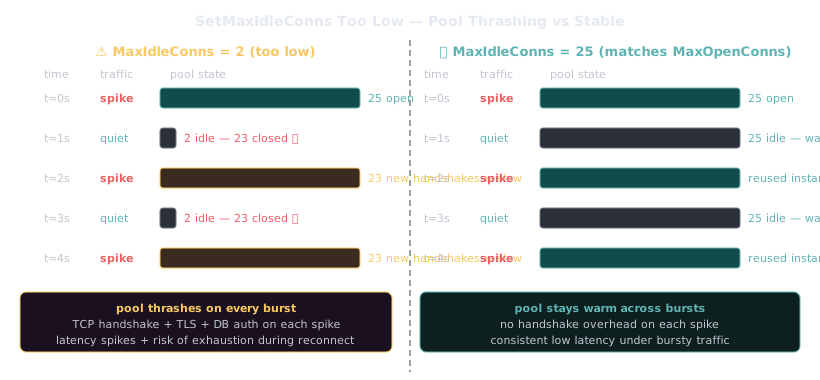
If MaxIdleConns < MaxOpenConns, connections get destroyed and recreated on every burst. This adds latency and can cause exhaustion during the reconnect window.
// ✅ Balanced configuration
db.SetMaxOpenConns(25)
db.SetMaxIdleConns(25)         // keep all of them warm
db.SetConnMaxLifetime(5 * time.Minute)
db.SetConnMaxIdleTime(1 * time.Minute)
Culprit #3 — Long-Running Queries Holding Connections
Each connection is occupied for the full duration of a query. If one query takes 30 seconds, that connection is gone for 30 seconds.
Normal query:   ──[query]──  (5ms)   → connection free quickly
Slow query:     ──────────────────────────────[query]── (30s)
                ↑ connection blocked for entire duration

Under load:
┌────────────────────────────────────────────────────┐
│ C1  [============================slow query=======] │
│ C2  [============================slow query=======] │
│ C3  [============================slow query=======] │
│ ...                                                 │
│ C25 [============================slow query=======] │
│                                                     │
│ New requests → queue → timeout ❌                   │
└────────────────────────────────────────────────────┘
Always use context with a deadline:
// ❌ No timeout — query can hang indefinitely
rows, err := db.Query("SELECT * FROM orders WHERE user_id = $1", userID)

// ✅ Query with timeout — connection released when context expires
func getOrders(ctx context.Context, db *sql.DB, userID string) ([]Order, error) {
    ctx, cancel := context.WithTimeout(ctx, 3*time.Second)
    defer cancel()

    rows, err := db.QueryContext(ctx,
        "SELECT id, total, status FROM orders WHERE user_id = $1", userID)
    if err != nil {
        return nil, err
    }
    defer rows.Close()

    var orders []Order
    for rows.Next() {
        var o Order
        if err := rows.Scan(&o.ID, &o.Total, &o.Status); err != nil {
            return nil, err
        }
        orders = append(orders, o)
    }
    return orders, rows.Err()
}
If the query exceeds 3 seconds, the context cancels, the connection is freed, and the caller gets a clear error instead of a silent hang.
Culprit #4 — No SetConnMaxLifetime, Connections Go Stale
Without a lifetime limit, connections live forever. The DB server — or a firewall/load balancer sitting between your app and DB — may silently close idle connections. Your pool thinks they’re alive. They’re not.
App Pool                         Firewall / DB Server
   │                                     │
   │  C1 open (idle for 10 min)          │
   │                                     │── closes C1 silently
   │                                     │
   │  New request tries to use C1 ───────┼──► "bad connection" ❌
   │                                     │
   │  Go retries with a new connection   │
   │  (adds latency + burns a new slot)  │
This is especially common with:
- AWS RDS Proxy (idle timeout: 10 min by default)
- PgBouncer in transaction mode
- Any NAT gateway with connection tracking
// ✅ Rotate connections before they go stale
db.SetConnMaxLifetime(5 * time.Minute)  // max age of any connection
db.SetConnMaxIdleTime(1 * time.Minute)  // max idle time before closing
Set ConnMaxLifetime lower than your infrastructure’s idle timeout. If RDS Proxy kills at 10 minutes, rotate at 5.
Culprit #5 — Context Not Propagated, Goroutines Pile Up
When a request is cancelled (user closes browser, upstream timeout fires), if you’re not using context, the DB query keeps running and holds the connection.
User cancels request at t=0ms
  │
  ├── HTTP handler returns
  │
  └── goroutine still running db.Query("SELECT...") ← no context
        │
        └── holds connection for 10 more seconds
              │
              └── 500 concurrent cancellations = 500 stuck connections
                    │
                    └── pool exhausted ❌
// ❌ Context ignored — query outlives the request
func handler(w http.ResponseWriter, r *http.Request) {
    rows, err := db.Query("SELECT * FROM big_table")
    // if client disconnects, query keeps running
    // ...
}

// ✅ Context flows through — query cancelled with the request
func handler(w http.ResponseWriter, r *http.Request) {
    rows, err := db.QueryContext(r.Context(), "SELECT * FROM big_table")
    // client disconnects → r.Context() cancelled → query stops → connection freed
    if err != nil {
        http.Error(w, "query failed", http.StatusInternalServerError)
        return
    }
    defer rows.Close()
    // ...
}
The rule: every DB call should accept and use a context.Context. No exceptions.
The Complete Fix — Sane Pool Configuration
func newDB(dsn string) (*sql.DB, error) {
    db, err := sql.Open("pgx", dsn)
    if err != nil {
        return nil, err
    }

    // How many connections can be open at once
    db.SetMaxOpenConns(25)

    // How many to keep warm (match MaxOpenConns for bursty traffic)
    db.SetMaxIdleConns(25)

    // Rotate connections to avoid stale/firewall issues
    // Set lower than your infra's idle timeout (RDS Proxy default: 10min)
    db.SetConnMaxLifetime(5 * time.Minute)

    // Close connections that have been idle too long
    db.SetConnMaxIdleTime(2 * time.Minute)

    // Verify the pool works at startup — fail fast
    ctx, cancel := context.WithTimeout(context.Background(), 5*time.Second)
    defer cancel()
    if err := db.PingContext(ctx); err != nil {
        return nil, fmt.Errorf("db ping failed: %w", err)
    }

    return db, nil
}
How to Catch This Before It Hits Production
sql.DB exposes pool stats. Export them to your metrics system on every scrape interval:
func recordDBStats(db *sql.DB, metrics *prometheus.GaugeVec) {
    stats := db.Stats()

    metrics.WithLabelValues("open").Set(float64(stats.OpenConnections))
    metrics.WithLabelValues("in_use").Set(float64(stats.InUse))
    metrics.WithLabelValues("idle").Set(float64(stats.Idle))
    metrics.WithLabelValues("wait_count").Set(float64(stats.WaitCount))
    metrics.WithLabelValues("wait_duration_ms").Set(
        float64(stats.WaitDuration.Milliseconds()),
    )
    metrics.WithLabelValues("max_idle_closed").Set(float64(stats.MaxIdleClosed))
    metrics.WithLabelValues("max_lifetime_closed").Set(float64(stats.MaxLifetimeClosed))
}
The signals to watch:
stat                  what it tells you
────────────────────  ──────────────────────────────────────────────
WaitCount ↑           requests queuing for a connection → pool too small
                      or connections are leaking
InUse == MaxOpen      pool is saturated right now
MaxIdleClosed ↑       MaxIdleConns too low, pool is thrashing
MaxLifetimeClosed ↑   normal rotation — expected if lifetime is short
WaitDuration ↑        users are feeling this — act immediately
Set an alert on WaitCount growing over time. That’s your earliest warning before users see errors.
The Mental Model
SetMaxOpenConns    → the size of your parking lot
SetMaxIdleConns    → reserved spots kept warm and ready
SetConnMaxLifetime → how long a car can stay before it must leave
SetConnMaxIdleTime → how long an empty spot waits before being released
Context            → the valet that cancels the reservation if you leave
rows.Close()       → actually returning the car to the lot
tx.Rollback()      → returning the car even when something went wrong
Miss any one of these and the lot fills up — even if the sign says “25 spaces.”
Key Takeaways
rows.Close()andtx.Rollback()are not optional — leak one and you leak a connectionSetMaxIdleConnsshould matchSetMaxOpenConnsfor bursty workloads- Always pass
context.Contextto every DB call — it’s your safety valve - Set
ConnMaxLifetimelower than your infra’s idle timeout - Export
db.Stats()to metrics —WaitCountis your canary
The pool config is one line. The discipline around it is the whole job.
Next up: Goroutines pile up into the hundreds of thousands even though CPU usage is flat — same format, same depth.